For game developers
Low Poly Island for Games: How the Saltlight Isles World Was Built

Short answer: a low poly island for a game is easiest to build as a set of small playable areas, not one big sculpted mesh. Saltlight Isles, our Mediterranean island world, is split into four regions with three scenes each. All 219 assets share one material and one 512 px gradient atlas, total 240,615 triangles as unique designs, and place 2,197 times across the whole island.
Most "low poly island" results are tutorials that model a single island mesh with a palm tree, or packs of loose islands to download. This breakdown covers the next step: how a whole island becomes a game level you can walk around. Asset counts and triangle totals come from the live product pages of the Saltlight Isles collection, checked in October 2026. Scene figures (placed instances, footprints, triangles in the assembled scene) were measured in our Blender scene files.
Start with a place, then split it into regions
An island tempts you to begin with the coastline. We began with a premise instead: a sun-bleached island in a timeless, fictional Mediterranean setting, late-morning light, whitewashed walls, terracotta roofs, olives and cypresses. No electricity, engines or real landmarks. That premise decides which assets exist and which do not.
The island was then divided by what a player does there, not by geography alone. Each region has its own mood and its own set of props, but all four draw on the same asset pool and the same atlas, so the island reads as one place.
| Region | What it holds | Scenes |
|---|---|---|
| Harbour Town | Whitewashed town on the south bay: plaza, stair lanes, bell-tower court | Market Square, Stair Lane, Bell Tower Court |
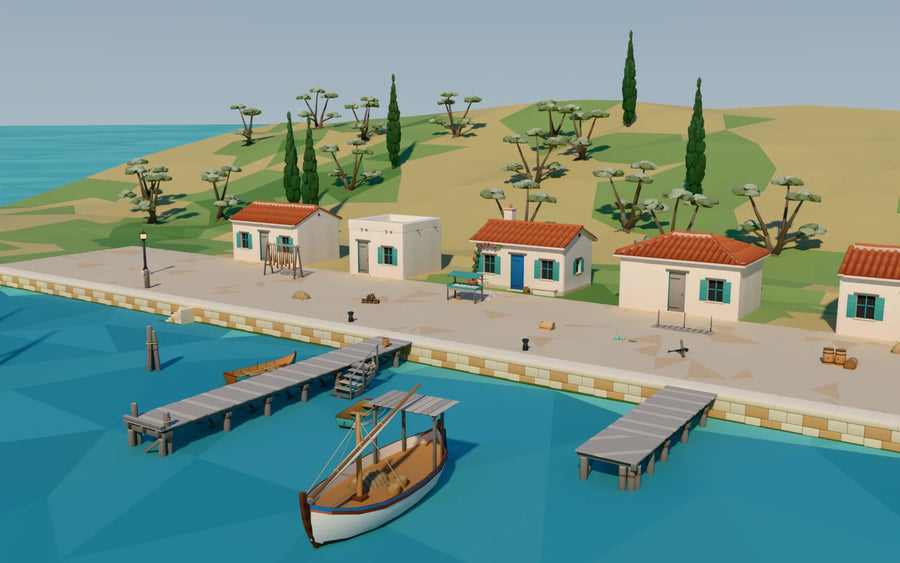
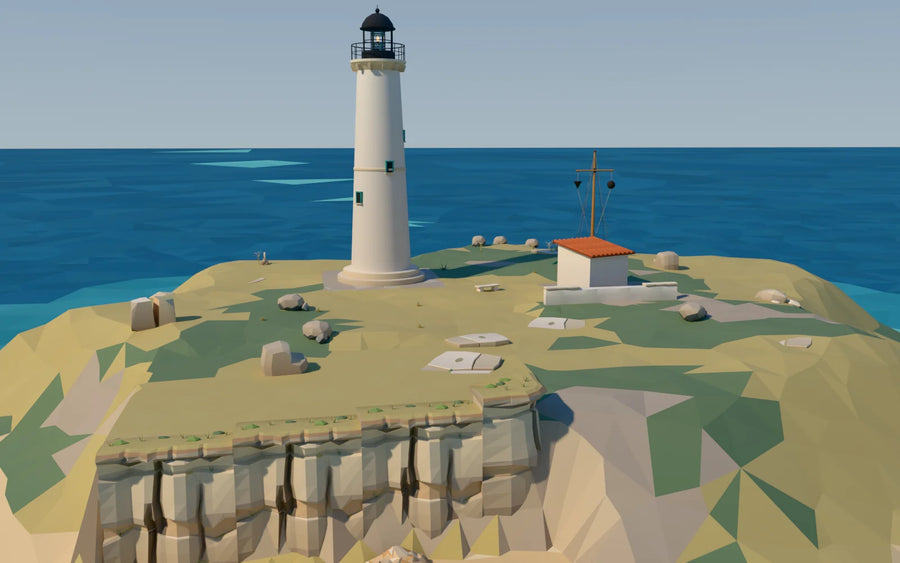
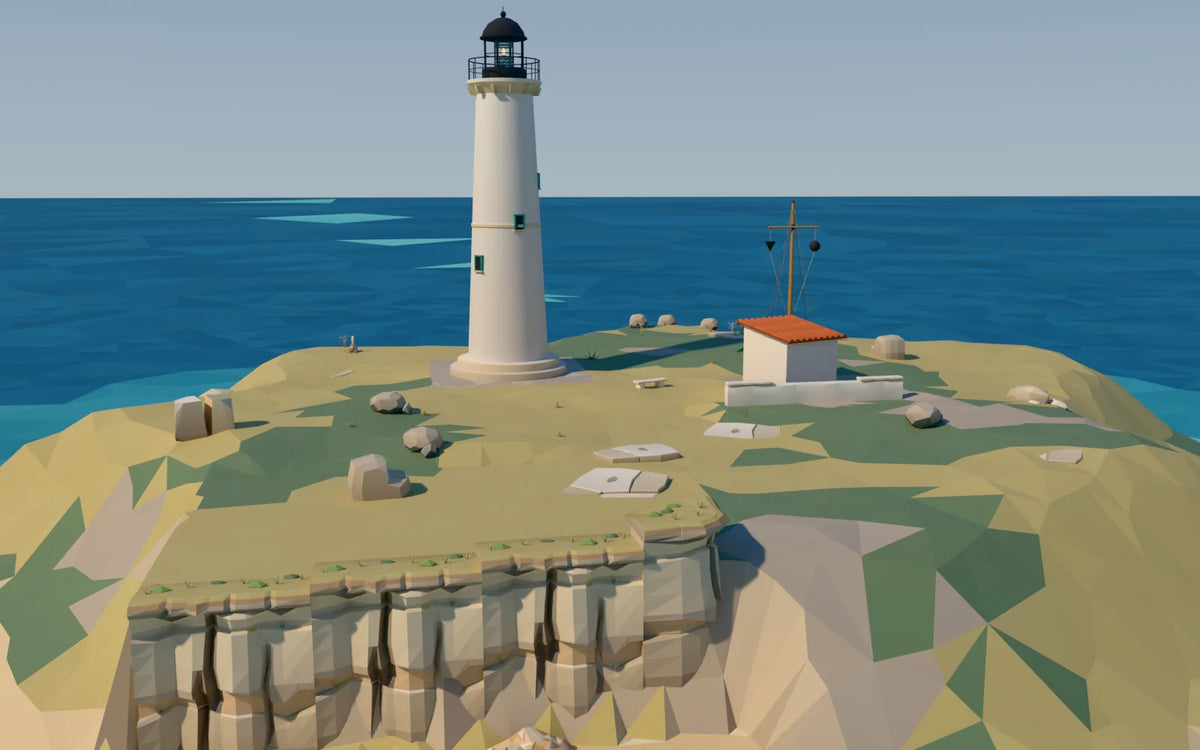
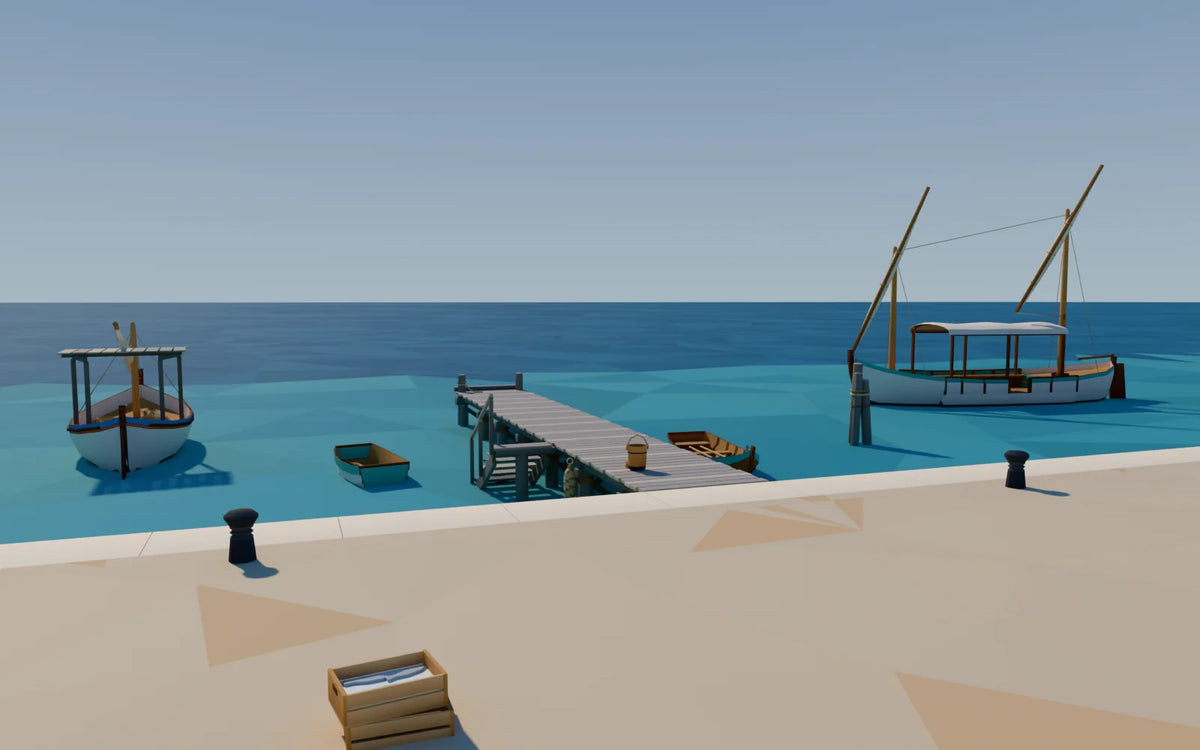
| Waterfront | Quay, piers and boatyard along the bay, lighthouse on the western islet | Fishing Quay, Boatyard Slip, Lighthouse Point |
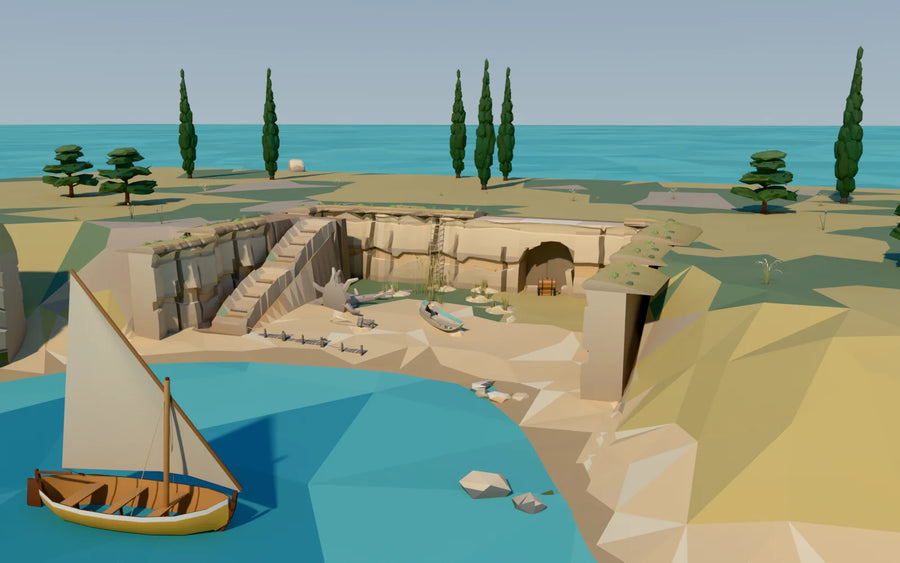
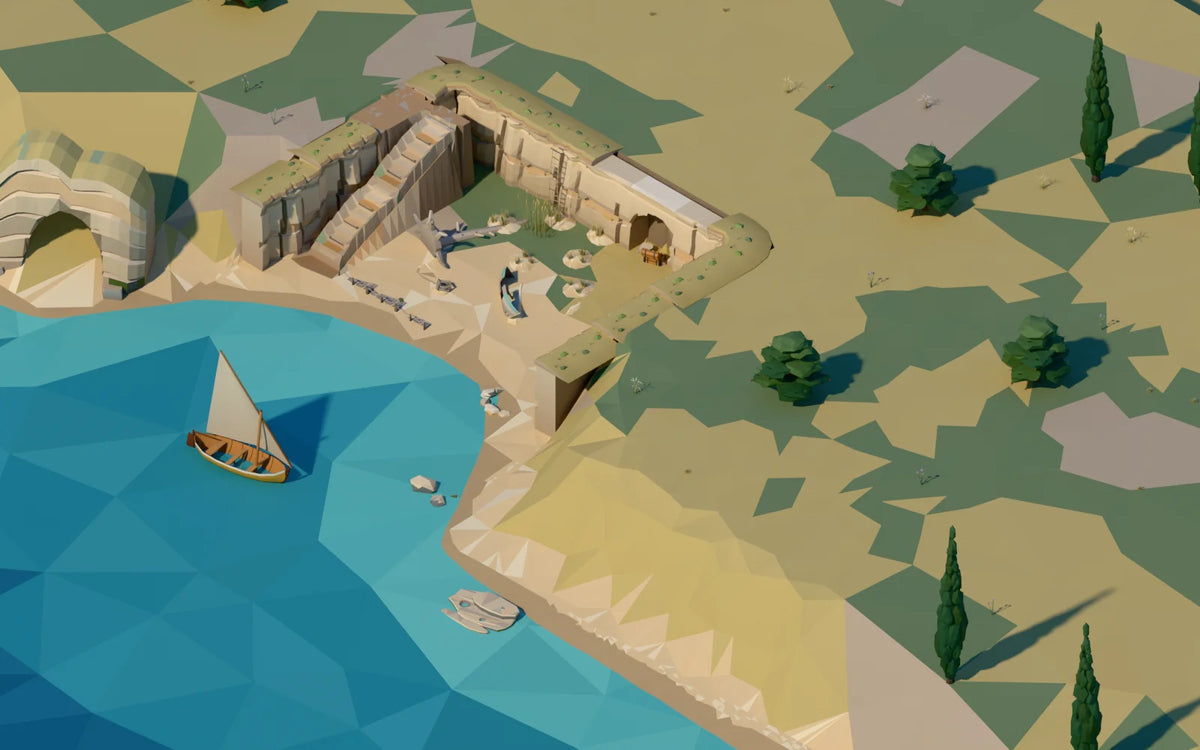
| Hills | Olive terraces, windmill ridge and a hidden sand cove | Olive Terraces, Windmill Ridge, Hidden Cove |
| Headland | Temple ruin, old fort and a cliff trail through cypress and pine | Temple of the Headland, Old Fort Gate, Cypress Ridge Trail |
The assets sit in four collections that map onto those regions: Saltlight Village (69 assets, 75,399 triangles), Saltlight Harbour (46 assets, 52,834), Saltlight Wilds (64 assets, 55,429) and Saltlight Ruins & Landmarks (40 assets, 56,953). Each asset has exactly one home collection, and a scene simply places the pieces it needs from any of them.
Twelve scenes: one gameplay job each
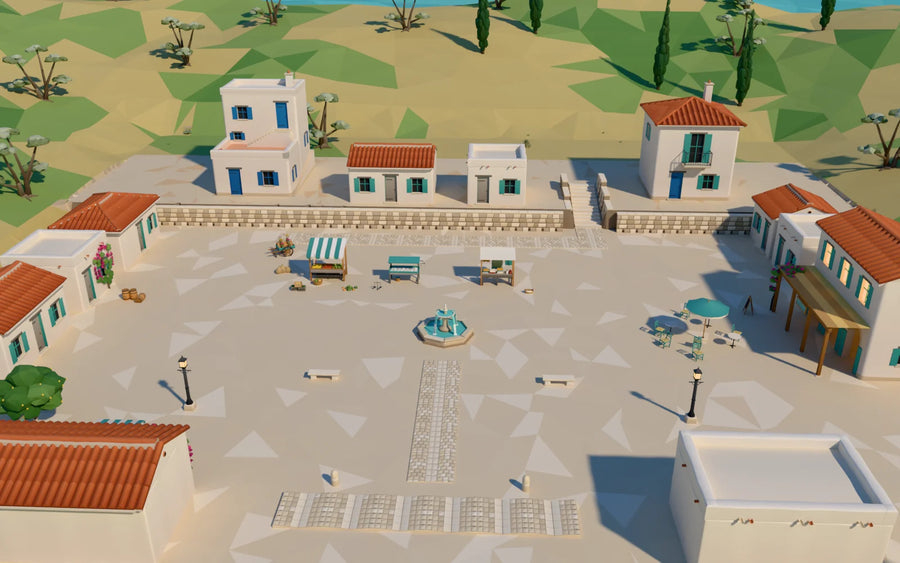
Every scene was planned around a single job a level designer might need: a hub, a traversal set piece, a docking level, a secret area. That keeps each site small enough to test and dress properly. The table lists each scene with its unique assets and triangle total from the product page, and the number of placed instances and triangles in the assembled scene file.
| Scene | Use | Site (m) | Unique assets | Asset triangles | Placed instances | Triangles placed |
|---|---|---|---|---|---|---|
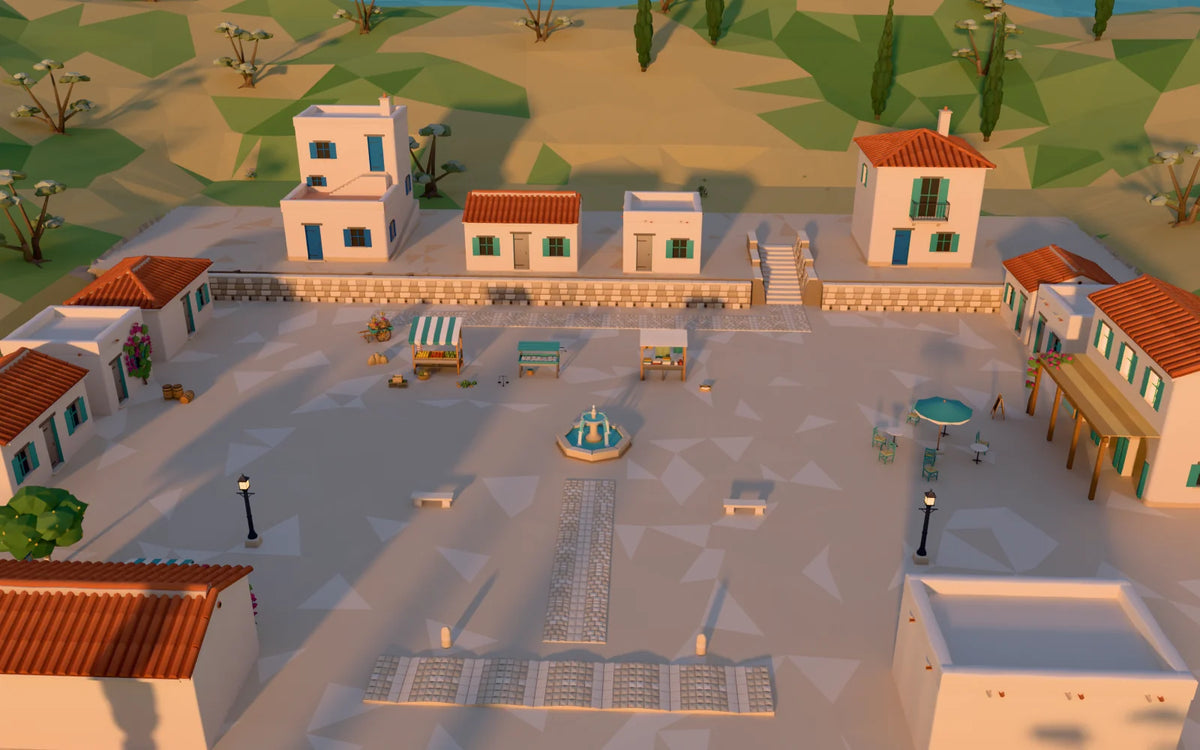
| Market Square | Hub for life-sim and adventure | 50 x 50 | 48 | 50,374 | 395 | 210,287 |
| Stair Lane | Traversal set piece | 30 x 50 | 46 | 27,755 | 457 | 161,299 |
| Bell Tower Court | Quest-giver and gathering | 40 x 40 | 33 | 41,020 | 131 | 159,306 |
| Fishing Quay | Docking and trading | 60 x 40 | 49 | 48,418 | 233 | 171,984 |
| Boatyard Slip | Crafting and builder | 40 x 40 | 33 | 33,200 | 134 | 110,548 |
| Lighthouse Point | Landmark and lookout | 60 x 60 | 30 | 21,330 | 66 | 43,447 |
| Olive Terraces | Farming and exploration | 60 x 60 | 28 | 29,987 | 270 | 227,850 |
| Windmill Ridge | Skyline landmark | 50 x 50 | 24 | 19,016 | 121 | 118,119 |
| Hidden Cove | Secret and treasure | 50 x 40 | 35 | 27,691 | 102 | 106,511 |
| Temple of the Headland | Puzzle and discovery | 60 x 50 | 32 | 34,257 | 158 | 175,133 |
| Old Fort Gate | Siege, stealth and climbing | 60 x 60 | 30 | 33,720 | 123 | 129,915 |
| Cypress Ridge Trail | Traversal and exploration | 40 x 60 | 30 | 30,458 | 149 | 184,156 |
The gap between the two triangle columns is the useful part. Asset triangles count each design once. Triangles placed count every copy in the scene, plus its terrain base and sea plane. Stair Lane uses only 27,755 triangles of unique geometry, but 457 placed pieces of wall, stair, roof and planting bring it to about 161,000. Olive Terraces is the heaviest at about 228,000 because dry-stone walls and olive trees repeat across a 60 x 60 m slope. Lighthouse Point is the lightest at about 43,000: a big site, but mostly bare rock and sea.
If you are setting a triangle budget for your own island, plan for repetition, not just for the asset list. Our guide How many triangles is low poly? has per-asset ranges to start from.
What goes into each scene file
A scene here is more than a nice render. Each one ships as BLEND and GLB and is built from the same assets you get as separate files, plus a few pieces that only make sense inside a level:
- A terrain base. Each site sits on a faceted terrain piece that blends into a coastline and a low poly sea plane. Terrain is part of the scene files, not a separate product.
- A sun and sky rig. The default is midday with the sun at 40 degrees, a warm key and cool sky fill. A golden-hour setup with the sun at 10 degrees is used for the warmer product renders. No lighting is baked, so you can relight in your engine.
- Three cameras. A hero still, a third-person gameplay camera at 1.7 m eye height on a 4.5 m boom, and an orthographic isometric camera at the classic 35.264 degree elevation and 45 degree azimuth. They give you a quick read on how the level frames from each angle.
- Spawn and NPC markers. Empty objects named SPAWN_ and NPC_ mark where a player starts and where characters could stand. Market Square has 2 spawn points and 12 NPC points; the quiet Windmill Ridge has 1 and 2. The world has no characters or animals of its own, so these markers are where your cast goes.
Solid assets such as buildings, boulders and the lighthouse include a simple collision proxy mesh, and the scene adds collision shapes for walkable terrain and ramps over stairs. As the product pages note, hide or convert the proxy on import: engines do not turn a mesh into a collider just because of its name, so assign it in your engine's import settings or with a small script. Small ground cover such as grass tufts has no proxy, so players walk through it.
One material for the whole island
Every one of the 219 assets uses the same gradient atlas material. The colour comes from a single 512 px texture where each cell holds a short vertical gradient of one hue, so whitewash, terracotta, olive green and sea-teal all live in the same image. Our texture atlas explainer walks through how that layout works cell by cell.
For an island, one material matters more than for a single room. A level that mixes houses, boats, rocks and trees from four separate packs usually brings four or more materials, each a separate draw per object. Here, each scene uses one material only. Lighthouse Point has 68 visible mesh objects drawing from 31 unique meshes, and Market Square has 397 objects from 50 unique meshes. Those numbers are counted in the scene file, before any engine batching; GPU instancing or static batching can merge the repeats further. We have not measured frame times in an engine, so treat them as a planning guide.
From scenes to a whole island
The Saltlight Isles World places all twelve scene sites on one island and joins them with paths, terrain, sea and scattered planting. In the assembled world file, that comes to 2,197 placed instances drawn from 219 designs, with about 1.78 million triangles visible at full detail across the whole island.
Nobody should render all of that at once on modest hardware, which is why the world is also cut into 89 terrain cells, each with its own scatter, exported as separate GLB files in world coordinates. You can stream cells in and out, load only the region a player is in, or use the one-file world for a small project or a fly-through. The All Scenes bundle gives you the twelve scenes and their assets without the world files.
Building your own island with the kits
If you want a different island rather than ours, the kits are built for that. A practical order:
- Block out the coast and cliffs. The Rocks & Cliffs Kit has 18 assets in 9,243 triangles, including cliff modules that stack, outer and inner corner caps, a sea stack, a rock arch and a cave mouth. Stacked cliff edges give a coastline a readable height quickly.
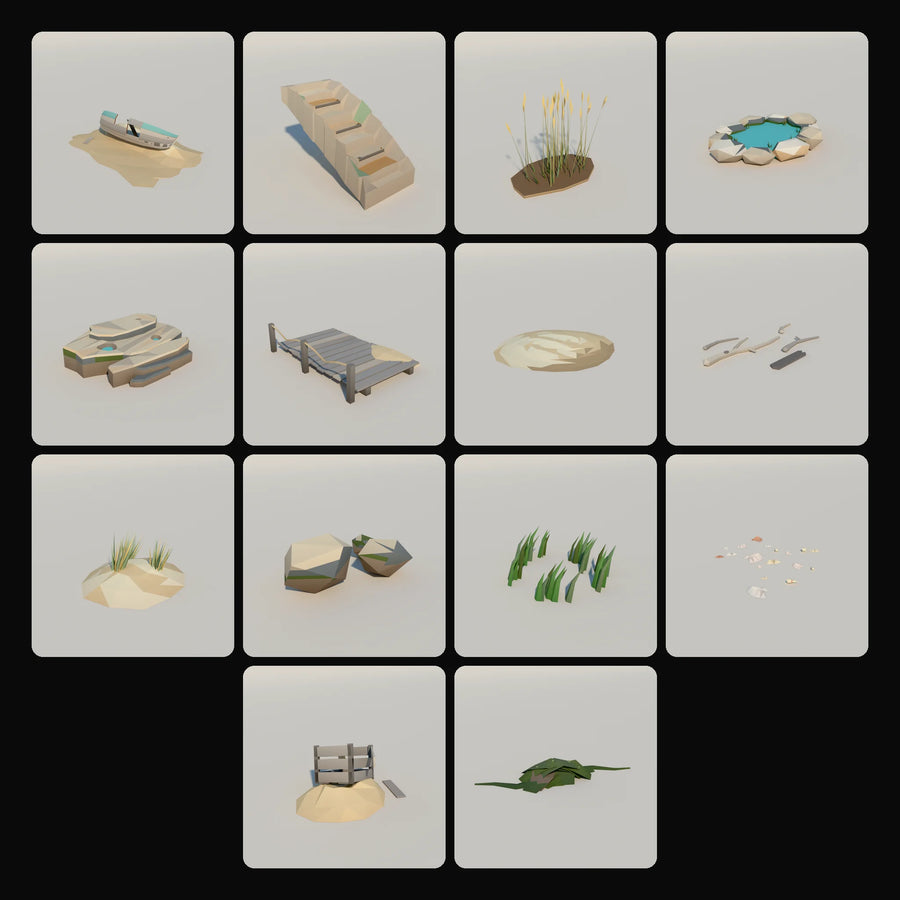
- Dress the shoreline. The Shore Kit adds sand, dune grass, tide pools, driftwood, a wreck, cliff steps and a boardwalk in 14 assets and 6,571 triangles.
- Place one settlement on the grid. Village houses, piers and quays snap on a 2 m grid. Our guide to low poly buildings covers the modular house pieces in detail.
- Plant in clusters. Trees and shrubs look more natural grouped by species and slope. Low poly trees, rocks and nature lists triangle counts by plant type.
- Add one landmark per region. A lighthouse, a windmill, a ruin: each gives players something to navigate by from across the island.
Assets come as BLEND, GLB, FBX and OBJ. If you are choosing an import format, see 3D file formats for games.
Common questions
What is a low poly island?
A stylized island scene built from meshes with few polygons and visible facets, often coloured with flat or gradient colours instead of detailed textures. It keeps file sizes and rendering costs low, which suits mobile, web and XR projects.
How many triangles does a low poly island level need?
It depends on how much repeats. As a reference, our twelve island scenes range from about 43,000 to about 228,000 placed triangles each on 30 to 60 m sites, and the full island is about 1.78 million triangles across 2,197 placed pieces.
Can I build my own island layout with these assets?
Yes. Every asset in the scenes is also delivered as a separate file, so you can rearrange them or start from an empty map. The scenes are a starting point, not a fixed layout.
Can I use the island in a commercial game?
Yes, under the Premade3D Standard License shown on each product page, which covers personal and commercial projects including games. Our 3D asset license guide explains what that covers.
Assets in this guide
- Scene collection
Saltlight Isles: All Scenes
219 assets · Saltlight Isles
€99,00
Includes 219 assets worth €1.601,00 separately
- World
Saltlight Isles World
219 assets · Saltlight Isles
€199,00
Includes 219 assets worth €1.601,00 separately
- Kit
Rocks & Cliffs Kit
18 assets · Saltlight Wilds
€48,00
Includes 18 assets worth €120,00 separately
- Kit
Shore Kit
14 assets · Saltlight Wilds
€32,00
Includes 14 assets worth €79,00 separately
- Scene
Fishing Quay: Scene
49 assets · Saltlight Isles
€59,00
Includes 49 assets worth €313,00 separately
- Scene
Hidden Cove: Scene
35 assets · Saltlight Isles
€59,00
Includes 35 assets worth €229,00 separately
- Scene
Lighthouse Point: Scene
30 assets · Saltlight Isles
€59,00
Includes 30 assets worth €212,00 separately
- Scene
Market Square: Scene
48 assets · Saltlight Isles
€59,00
Includes 48 assets worth €307,00 separately